





Still Over the Limit? 6 Reasons Cannabis Stays in Your System Overnight
Published by Drug Driving Solicitors, specialist UK solicitors defending drivers facing drug driving charges.
Cannabis can create an awkward morning-after problem for drivers. The noticeable effects may have disappeared, you may have slept normally, and you may feel entirely capable of driving. None of those things, however, tells you exactly how much delta-9-tetrahydrocannabinol, or THC, remains in your bloodstream.
In England and Wales, Section 5A of the Road Traffic Act 1988 makes it an offence to drive, attempt to drive, or be in charge of a motor vehicle with a specified controlled drug above its prescribed limit. For cannabis, the THC limit is 2 micrograms per litre of blood. The government describes cannabis as part of its "zero tolerance approach" to certain drugs associated with illegal use, although the threshold is deliberately set above zero to allow for accidental exposure.
1. Regular Cannabis Use Can Leave THC Detectable for Longer
Repeated Use Changes the Clearance Pattern
How frequently cannabis is used can make a major difference to what remains in the body the following morning. Someone who uses cannabis occasionally may have a substantially different THC profile from someone who consumes it several times a week or every day.
Research involving chronic cannabis users has found measurable THC persisting during sustained abstinence. In one controlled study, some frequent users still had detectable whole-blood THC six full days after entering a monitored environment where no further cannabis use was permitted.
The Previous Evening May Not Be the Whole Story
For a regular user, a blood test may therefore reflect more than the cannabis consumed during one particular evening. Repeated exposure allows THC to accumulate within body tissues, which can alter the way concentrations decline after the most recent use.
This does not mean every frequent cannabis user will remain above the legal driving limit for several days. Detectability is not the same as exceeding 2 micrograms per litre. It does mean that clearance can vary considerably, making simple assumptions such as "I stopped last night, so I must be clear this morning" unreliable.
2. Edibles Can Push the THC Timeline Later
Eating Cannabis Produces a Different Absorption Pattern
Smoking or vaping cannabis delivers THC through the lungs, allowing blood concentrations to rise rapidly. Edibles take a different route because THC must pass through the digestive system and undergo metabolism before its full effects develop.
Controlled research has found that oral cannabis has a slower and considerably more variable pharmacokinetic profile than inhaled cannabis. Peak effects may occur roughly 1.5 to 3 hours after ingestion, while blood concentrations can follow a different pattern depending on dose, formulation and individual response.
Different Products Can Produce Different Timelines
A cannabis brownie, oil, capsule, smoked joint and vaporised product should not be expected to behave identically in the body. Reviews of oral THC research have found considerable variation between products, with delayed peak concentrations compared with inhaled cannabis.
That matters particularly when an edible is taken late in the evening. Counting a fixed number of hours from the moment it was swallowed can create false confidence because absorption itself may still have been developing for part of that period. Sleeping overnight does not provide a reliable measurement of the THC concentration that will be present the following morning.
3. Feeling Sober Does Not Reveal Your Blood THC Level
Subjective Effects and THC Concentration Are Different Measures
People naturally judge cannabis according to how they feel. Once the altered perception, relaxation, drowsiness or feeling of being "high" disappears, it can seem logical to assume that the drug is no longer relevant.
The difficulty is that subjective sobriety is not a blood test. Research examining cannabis biomarkers and driving-related performance has found that relationships between blood THC, subjective intoxication and actual impairment are complex and often relatively weak.
Section 5A Does Not Depend on Whether You Feel Impaired
This distinction has particular legal importance because the Section 5A offence is based on exceeding the specified concentration. Prosecutors do not have to prove that the driver was obviously impaired in order to establish the specified-limit offence.
Government guidance specifically states that it can be illegal to drive with certain levels of illegal drugs in the blood even where those drugs have not affected the person's driving. Feeling completely normal the morning after cannabis use therefore cannot establish whether the THC level is above or below the statutory threshold.
4. THC Is Stored Differently From Alcohol
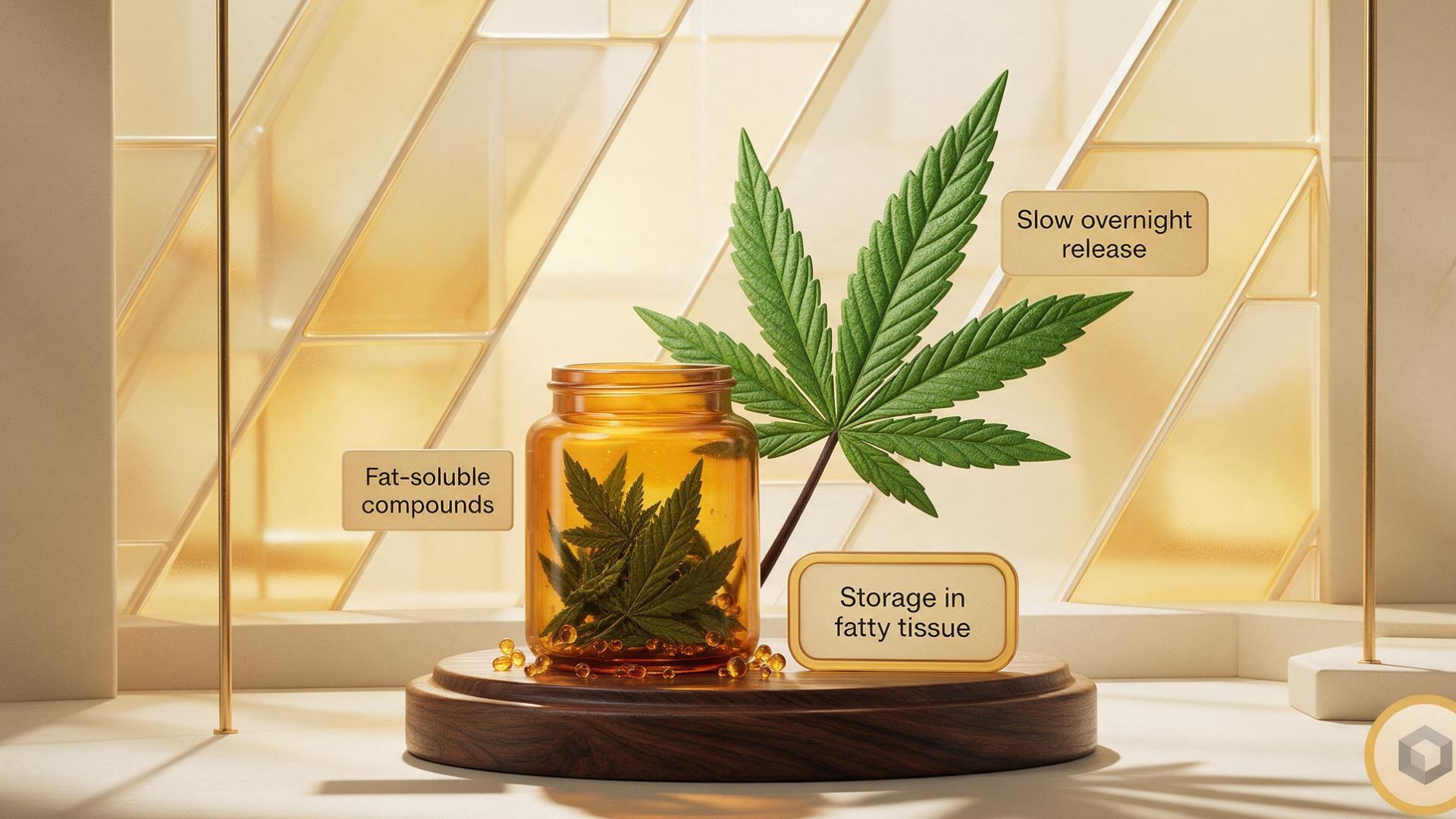
THC Is Highly Fat-Soluble
Cannabis cannot simply be treated as though it follows the same clearance pattern as alcohol. THC is highly lipophilic, meaning that it readily distributes into fatty tissues after entering the bloodstream.
Scientific reviews describe THC being rapidly taken up into body tissues before later being released from deeper storage compartments. This contributes to a multiphase elimination pattern rather than a straightforward, predictable fall in concentration from hour to hour.
Stored THC Can Re-Enter the Circulation
After THC has moved into fatty tissue, small amounts can subsequently redistribute into the bloodstream. This is one reason the terminal elimination phase can continue for considerably longer than the period during which a person notices obvious psychoactive effects.
Alcohol is therefore a poor model for estimating cannabis clearance. With alcohol, people sometimes attempt rough calculations based on units consumed and elapsed time. Cannabis pharmacokinetics are sufficiently different and variable that a similar hourly rule cannot reliably predict whether someone's THC concentration will fall below the driving threshold by morning.
5. The Cannabis Limit Is Set Very Low
It Is Not a Threshold for Severe Intoxication
The prescribed THC limit in England and Wales is 2 micrograms per litre of blood. Cannabis is one of the drugs placed within the government's "zero tolerance approach", under which low limits were chosen rather than limits intended to represent a particular degree of driving impairment.
Calling it a zero-tolerance approach does not mean the legal concentration is literally zero. The government deliberately set the cannabis threshold slightly above zero so that accidental exposure would not normally trigger the offence.
The Offence Focuses on the Laboratory Result
Section 5A therefore differs from the separate offence of driving while unfit through drugs. For the specified-limit offence, the central question is whether the concentration of the controlled drug exceeded the prescribed level, rather than whether the prosecution can demonstrate severe intoxication or visibly poor driving.
This explains why someone can feel that their driving ability has returned to normal yet still potentially face an issue under the specified-limit legislation. The threshold should not be interpreted as the point at which cannabis suddenly begins causing noticeable impairment.
6. Individual Biology Makes Clearance Difficult to Predict
Metabolism and Body Composition Differ Between People
There is no single cannabis clearance timetable that applies equally to everybody. THC is processed through several stages involving absorption, distribution into tissues, liver metabolism and eventual elimination, and each of those processes can vary between individuals.
Body size and composition may influence THC distribution because of the drug's affinity for fatty tissue. Metabolic differences, frequency of use, dose and route of administration can also affect the resulting concentration profile. Research on edible cannabis has likewise found that body composition may influence some pharmacokinetic measures, although the relationship is not sufficiently consistent to create a reliable personal formula.
Hydration Is Not a Reliable Shortcut
Food and fluid intake can influence measured drug concentrations and absorption patterns, and government material expressly notes that physical characteristics and eating or drinking can affect blood concentrations. However, drinking large quantities of water should not be treated as a dependable way to "flush" THC from the bloodstream.
For drivers, the practical problem is unpredictability. Two people who used a similar product at the same time could have different concentrations the following morning. Body composition, metabolism, previous cannabis exposure, dose and method of consumption all make it difficult to translate elapsed hours into a guaranteed laboratory result.
Why Overnight Is Not a Reliable Cut-Off
A night's sleep can make someone feel considerably different from how they felt after using cannabis, but sleep itself does not establish that the legal THC threshold has been crossed in the opposite direction. THC is fat-soluble, clearance varies widely, regular use can extend detection, edibles can change the timing of absorption, and the legal test does not depend on how sober somebody feels. For that reason, there is no universal morning-after formula that can guarantee a driver is below the specified cannabis limit.
Frequently Asked Questions
Does a Positive Roadside Cannabis Test Mean I Will Automatically Be Charged?
No. A roadside saliva test is a preliminary screening procedure rather than the evidential measurement used to establish the Section 5A blood concentration. CPS guidance states that current roadside devices screen for THC and cocaine and that, following a positive result, a suspect can be arrested and an evidential blood specimen required.
Whether a prosecution ultimately follows will depend on the evidential blood result and the circumstances of the case. Issues surrounding the lawfulness of the procedure, specimen handling, analytical evidence and possible statutory defences can also require examination, which is why specialist advice may be valuable at an early stage.
Is There a Specific Number of Hours I Should Wait Before Driving After Cannabis?
There is no official waiting period that guarantees someone will be below the THC limit. Government guidance says it cannot provide dosage guidance that equates to the specified limits because metabolism and other physical variables differ considerably between individuals.
Unlike rough alcohol calculations, elapsed time after cannabis use cannot reliably predict an individual's blood THC result. Product strength, route of administration, frequency of use and personal pharmacokinetics can all affect the outcome.
Can I Be Charged Even If My Driving Looked Completely Normal?
Yes. Section 5A is a specified-limit offence, meaning impairment does not have to be proved where the prosecution establishes that the relevant controlled drug exceeded its prescribed concentration.
However, a roadside preliminary drug test is not available simply because the police have stopped a vehicle. Under Section 6 of the Road Traffic Act 1988, preliminary testing powers arise in specified circumstances, including reasonable suspicion of drugs, certain moving traffic offences, and road traffic accidents.
How Long Can Cannabis Remain Detectable in Blood?
There is no single answer. THC can fall rapidly after occasional inhaled use, while frequent cannabis use can produce much longer detection periods. Research involving chronic users has demonstrated detectable THC in some participants after several days of monitored abstinence.
It is important to distinguish between being detectable and being above the legal driving limit. A laboratory may detect a very small amount of THC even though the concentration is below 2 micrograms per litre. Detection studies therefore cannot be used as a precise calculator for whether a particular driver would exceed the statutory threshold.
Does It Matter If Cannabis Was Prescribed or Legally Used Abroad?
Where a specified controlled drug has been lawfully prescribed or supplied for medical purposes and taken in accordance with the relevant medical directions, Section 5A provides a statutory medical defence. The defence does not protect somebody who drives while actually impaired by the medication.
Recreational cannabis that was legally consumed in another country does not automatically provide a defence to a driving offence committed in England or Wales. Likewise, using a cannabis product informally for perceived medical reasons is not the same as satisfying the statutory medical defence. The exact position involving prescribed cannabis or a particular medicine should be assessed on its own facts.
What Should I Do If I Am Charged After Using Cannabis the Previous Night?
Seek specialist legal advice as early as possible. A drug driving case can involve more than the fact that cannabis was consumed. The timing and method of use, the evidential blood result, the circumstances leading to the preliminary test and the procedures followed when obtaining and analysing the specimen may all be relevant.
Drug Driving Solicitors focus on defending motorists facing drug driving allegations across the UK. If you have been charged after a cannabis blood test showed a result above the applicable limit, contact Drug Driving Solicitors for a free and confidential initial consultation.